The Australian job market in 2026 looks nothing like it did two years ago. If you’re still using the same job search strategies from 2024, you’re competing with one hand tied behind your back.
AI is reshaping entire industries. Hiring managers’ expectations have fundamentally shifted. And the gap between what job seekers think works and what actually works has never been wider.
After helping hundreds of internationally-trained professionals navigate the Australian job market over the past 8 years—and analyzing data from 60+ job search assessments completed in 2026—I can tell you exactly what’s changed, what employers are looking for, and why most job seekers are getting it wrong.
The Current State: What’s Different in 2026
AI Disruption Is Real (And It’s Not What You Think)
Let’s address the elephant in the room: yes, AI is taking jobs. But not in the way most people assume.
Repetitive roles—data entry, basic customer service, simple reporting tasks—are being automated rapidly. If your job can be described as “do the same thing following the same process every day,” you need to make a career direction decision now, not later.
But here’s what’s more concerning for job seekers: AI is also making the job search itself harder.
Why? Because everyone now has access to the same AI resume writers, the same cover letter generators, the same LinkedIn optimization tools. The result? Hiring managers are drowning in identical-sounding applications that all use the same corporate buzzwords and lack genuine human voice.
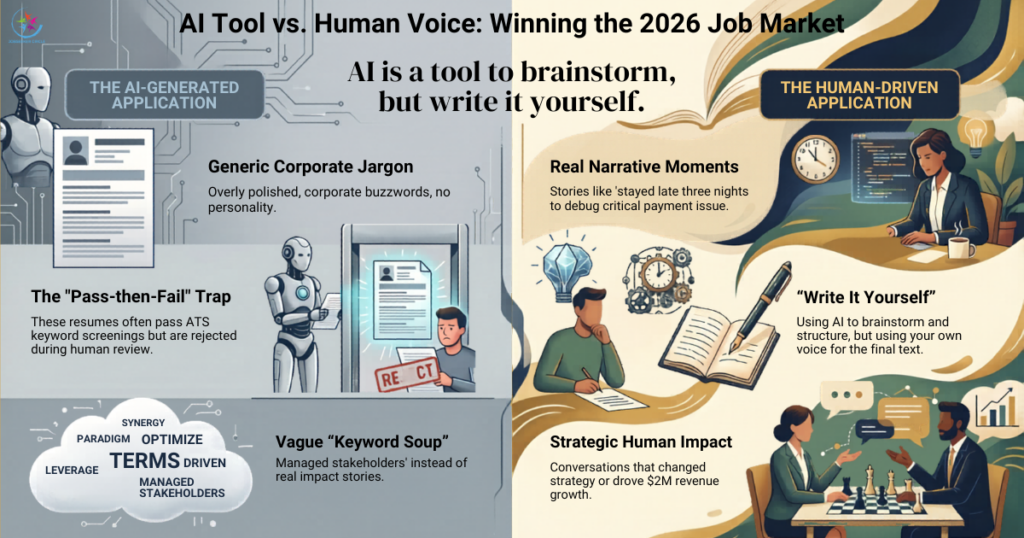
Our data shows a clear pattern: professionals who rely entirely on AI to write their resumes are not getting traction. The applications get through ATS systems, but they die at the human review stage because they read like… well, like AI wrote them.
The reality: AI is a tool, not a replacement. Use it to brainstorm, structure your thoughts, and identify gaps—but write in your own voice.
The 3-Factor Match: Why Generic Applications Fail
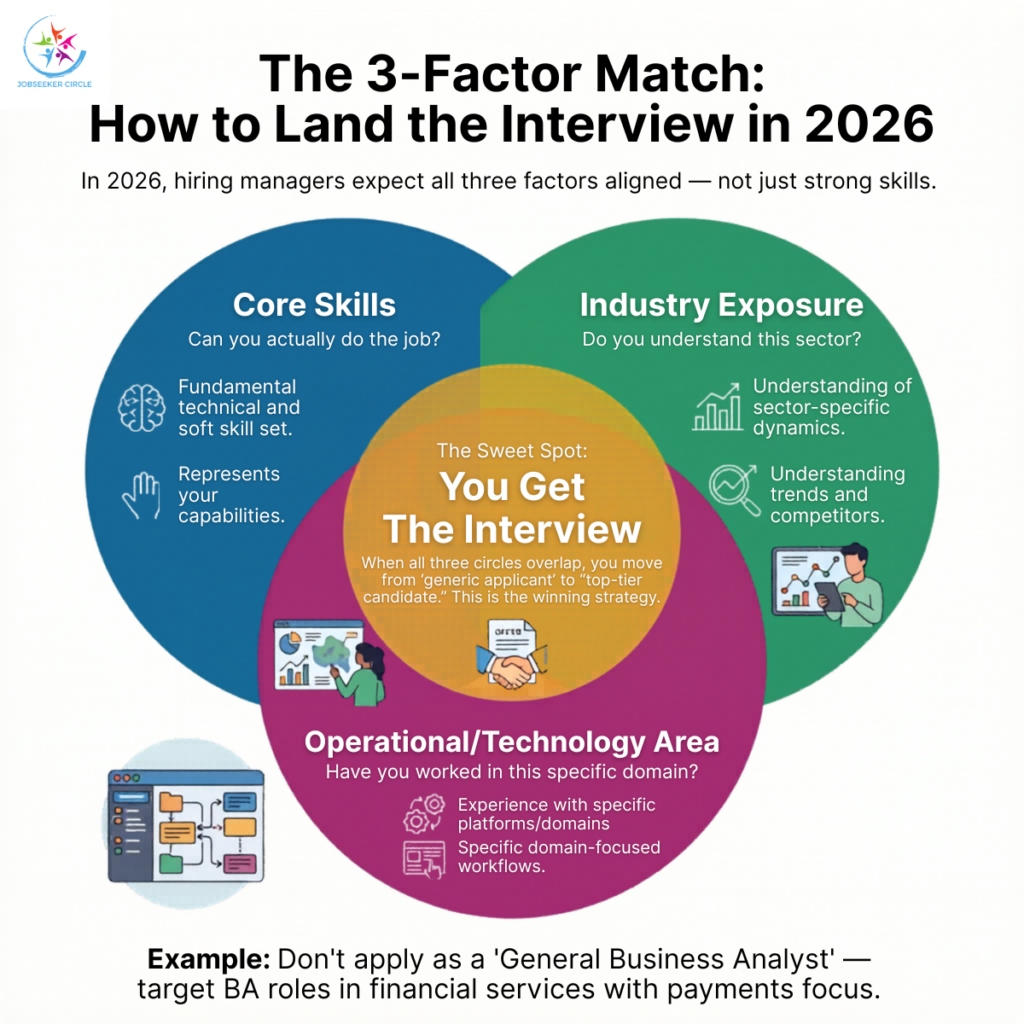
Here’s what most job seekers don’t understand about the 2026 Australian job market: hiring managers now expect a three-way alignment before they’ll even consider you.
The Three Factors:
- Core skills – Can you actually do the job?
- Industry exposure – Do you understand this sector?
- Operational/technology area – Have you worked in this specific domain?
Five years ago, having strong core skills was enough. You could be a great Business Analyst in retail and transition to banking because “analysis is analysis.”
Not anymore.
In 2026, hiring managers want all three factors aligned. Let me give you a real example:
Scenario: You’re a Business Analyst with 8 years of experience in retail, specializing in inventory management systems.
What doesn’t work: Applying for any BA role in any industry because “I’m a good analyst.”
What works: Targeting BA roles in retail/e-commerce companies specifically in supply chain, logistics, or inventory optimization. Or targeting BA roles in technology companies that build inventory management software.
See the difference? You’re not just matching on skills—you’re showing industry exposure AND operational area alignment.
This is why generic applications fail. You might have the skills, but if a hiring manager sees 50 applications and 10 of them show all three factors while yours shows only one, you’re not getting the call.
The Hidden Job Market Is Bigger Than Ever
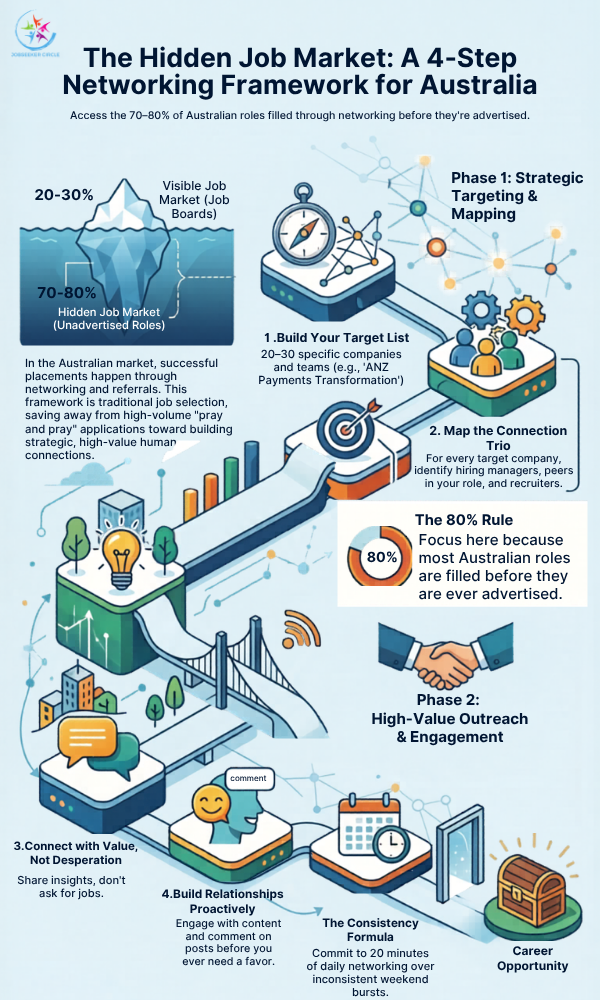
Here’s a stat that should change how you approach your job search: most roles in the Australian market are filled before they’re publicly advertised.
I’m not talking about a small percentage. Based on our client outcomes over the past year, approximately 70-80% of successful placements came through networking and referrals, not public job boards.
This isn’t a secret. But most job seekers still spend 90% of their time applying through Seek, LinkedIn Jobs, and company career pages, and only 10% of their time networking.
That ratio needs to flip.
What Hiring Managers Actually Want in 2026
Let’s cut through the noise. After working with hundreds of professionals and seeing what actually leads to job offers, here’s what matters:
1. Targeted Positioning Over Broad Experience
Hiring managers don’t want to figure out how your experience fits their role. They want you to show up already positioned for it.
Bad approach: “I have 10 years of project management experience across multiple industries.”
Good approach: “I have 6 years managing digital transformation projects in financial services, specifically payments and core banking systems.”
The second candidate has “less” experience but is infinitely more attractive because the fit is obvious.
2. Evidence of Results, Not Just Responsibilities
Your resume shouldn’t read like a job description. It should read like a highlight reel of what you actually achieved.
Bad: “Responsible for managing stakeholder relationships and delivering project milestones.”
Good: “Led cross-functional team of 12 to deliver payment gateway integration 6 weeks ahead of schedule, enabling $2M in additional quarterly revenue.”
See the difference? One is a list of duties. The other is a story of impact.
3. Australian Market Awareness
This is particularly critical for internationally-trained professionals. Hiring managers can tell within 30 seconds whether you understand the Australian workplace culture, recruitment expectations, and market dynamics.
Red flags that scream “I don’t understand the Australian market”:
- Resume longer than 3 pages
- Photo on resume
- Including age, marital status, or personal details
- No local phone number
- Salary expectations in USD or other currencies
- References that are all from overseas
Green flags that signal market awareness:
- Clean, ATS-friendly format
- Australian phone number (or clear note: “Australian citizen, currently based in [location], available to start [date]”)
- Results quantified in AUD
- Understanding of Australian industry players
- Awareness of local compliance/regulatory context when relevant
Why Traditional Job Search Strategies Are Failing
Let me debunk three myths that are costing job seekers months of wasted effort.
Myth #1: “Apply to 100+ Jobs and Someone Will Respond”
I hear this constantly: “I’ve applied to 200 jobs and heard nothing back.”
Here’s the truth: volume doesn’t work. Quality does.
The data from our 60+ job search assessments shows that most professionals score below 50% on Application & Positioning—meaning they’re applying broadly without proper targeting.
What actually works: 30-40 applications per week, but with these conditions:
- Each application is targeted (all three factors aligned)
- Resume is customized for each role
- You research the company before applying
- You follow up strategically
Follow-up is critical. An application without follow-up is like sending a letter and never checking if it arrived. But most job seekers follow up the wrong way—or don’t follow up at all.
Here’s what actually works:
If You Applied Through a Recruiter:
Day 2-3: Follow up via email or call. Simple message: “I applied for [role] on [date] and wanted to confirm you received my application. Happy to provide any additional information you need.”
Day 7: If no response, one more follow-up. After that, move on—don’t pester.
Why this works: Recruiters are busy. A polite follow-up shows you’re serious and reminds them you exist. Most candidates don’t do this.
If You Applied Directly to a Company:
Not everyone can identify the hiring manager (and that’s okay). Here’s a more realistic approach:
Step 1: Find someone currently working at the organization—ideally in a similar role or team.
How to find them: LinkedIn. Go to the company page → “People” → Filter by current employees → Search for your role or team.
Step 2: Reach out with a genuine question about culture, not a job ask.
Message template: “Hi [Name], I recently applied for the [role] position at [Company] and I’m really interested in the work your team is doing around [specific area]. Would you be open to a quick chat about the team culture and what it’s like working there? I’d appreciate any insights you can share.”
Why this works: You’re asking about culture (non-threatening), not asking for a referral (which feels pushy). This opens a conversation.
Step 3: During the conversation, you can naturally ask:
- “Do you happen to know who’s leading the hiring for this role?”
- “Would you be comfortable putting in a word or asking for feedback on my application?”
Important: You’re not asking for a referral (yet). You’re asking if they can help you get feedback. This is a much lower ask and feels more genuine.
Step 4: If they’re willing, follow up with a thank you and keep them posted on the outcome.
Reality check: Not every person will respond. Not every conversation will lead to a contact with the hiring manager. But even a 20% response rate means 1 in 5 applications now has internal advocacy—your competition isn’t doing this at all.
Most people don’t follow up this way because it feels like extra work. But this is exactly why it works—your competition isn’t doing it either.
Myth #2: “AI Can Write My Resume Better Than I Can”
AI can help structure your resume. It can suggest better phrasing. It can identify gaps.
But fully AI-generated resumes are failing in 2026.
Why? Two reasons:
First, they’re easy to spot. Hiring managers have read thousands of applications. They can tell when something was written by ChatGPT. The language is too polished, too corporate, too… generic.
Second, they lack the human element that actually matters. Your resume needs to tell your story in your voice. AI doesn’t know the specific project where you stayed late three nights to debug a critical issue. It doesn’t know the conversation you had with a stakeholder that changed the entire direction of a strategy.
Those details—the human, specific, real moments—are what make you memorable.
Use AI as a tool, not a crutch. Let it help you brainstorm. Then write it yourself.
Myth #3: “ATS Optimization Is All That Matters”
Here’s what actually happens with your application:
- ATS screening – Does your resume have the right keywords? (Pass/Fail: 60-70% pass)
- Human review – Does a recruiter or hiring manager actually want to talk to you? (This is where 90% fail)
Most job seekers obsess over step 1 and completely neglect step 2.
The result? Resumes that pass ATS but read like keyword soup. They’re technically optimized but practically unreadable.
Your resume needs to serve two audiences:
- The ATS (include relevant keywords naturally)
- The human reader (tell a clear, compelling story)
If you optimize for ATS at the expense of human readability, you’ll get through the gate and then immediately get rejected.
The Non-Negotiable: Networking in 2026
Let me be direct: networking is not optional. It’s not a “nice to have.” It’s THE differentiator between job seekers who land roles in 8 weeks and those who are still searching 8 months later.
Based on our client outcomes, 70-80% of successful placements came through networking and referrals, not cold applications.
So why don’t more people network? Usually one of three reasons:
- “I don’t know how to network in Australia”
- “I’m uncomfortable reaching out to strangers”
- “I don’t have time—I need to apply to jobs”
All three are understandable. All three are costing you months of job search time.
The Australian Networking Approach That Actually Works
Here’s a tactical framework I teach every client:
Step 1: Build Your Target Company List
Don’t network randomly. Network strategically.
Create a list of 20-30 companies where you’d genuinely want to work. Be specific. If you’re a Business Analyst in financial services, don’t just write “ANZ, CBA, Westpac.” Write:
- ANZ – Payments Transformation team
- CBA – Digital Banking division
- Macquarie – Technology & Operations group
Why the specificity matters: When you reach out to someone, you can say “I’m specifically interested in your Payments Transformation work” rather than “I’m interested in ANZ.”
Step 2: Identify Three Types of Connections at Each Company
For each target company, find:
- Hiring managers – People leading teams you want to join
- Peers in your role – People already doing the job you want
- Talent Acquisition team – Recruiters hiring for your function
How to find them: LinkedIn search. Go to the company page, filter by current employees, search by role.
Step 3: Connect With Value, Not Desperation
The worst LinkedIn message: “Hi, I’m looking for a job. Do you have any openings?”
The best LinkedIn message: “Hi [Name], I noticed your recent post about [specific topic]. I recently worked on something similar at [company] and found [insight]. Would love to connect and exchange ideas about [topic].”
See the difference? One is asking. One is offering value.
Step 4: Build Relationships Before You Need Them
Don’t only reach out when you need something. Engage with people’s content. Comment thoughtfully on their posts. Share relevant articles.
When you eventually do reach out about an opportunity, you’re not a stranger—you’re someone they recognize.
LinkedIn: Your Networking Infrastructure
LinkedIn isn’t just a digital resume. It’s your networking infrastructure for the Australian job market.
What actually works on LinkedIn in 2026:
Your profile: Not just a resume copy-paste. Write it like you’re having a conversation. Include specific achievements, not generic responsibilities.
Your activity: Comment on posts from people at your target companies. Share insights from your experience. Don’t just like—add value.
Your outreach: Personalize every connection request. Reference something specific (their post, their company’s recent news, a shared interest).
Your consistency: 15-20 minutes daily beats 3 hours on Sunday. Show up regularly.
Regional Differences: Where the Jobs Actually Are
The Australian job market isn’t uniform. Where you search matters.
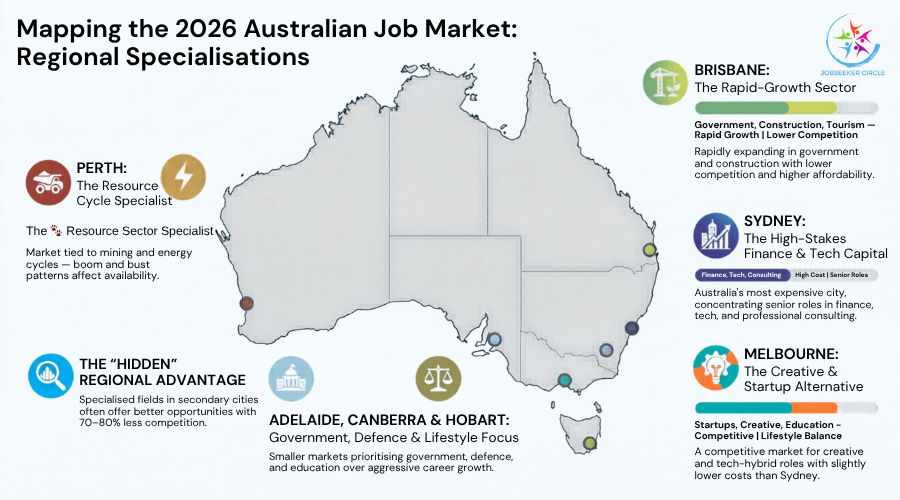
Sydney
Strengths: Finance, tech, professional services, consulting Who thrives here: Senior professionals, specialists in finance/tech, people comfortable with high cost of living Reality check: Most expensive city, but highest concentration of senior roles and international companies
Melbourne
Strengths: Tech startups, creative industries, education, healthcare Who thrives here: Mid-career professionals, people valuing work-life balance, creative/tech hybrid roles Reality check: Competitive market, but slightly lower cost of living than Sydney
Brisbane
Strengths: Government, construction, mining/resources, tourism Who thrives here: Professionals in infrastructure, resources, public sector Reality check: Growing rapidly, lower cost of living, fewer roles than Sydney/Melbourne but less competition
Perth
Strengths: Mining, resources, energy Who thrives here: Engineers, project managers, technical specialists in resources sector Reality check: Market heavily tied to resources sector—boom and bust cycles affect job availability
Adelaide, Canberra, Hobart
Strengths: Government, defense, education, niche industries Who thrives here: Public sector professionals, researchers, people seeking lifestyle over career growth Reality check: Smaller markets, fewer roles, but lower competition and cost of living
Strategic insight: Don’t just chase Sydney/Melbourne because they’re the biggest cities. If you’re in a specialized field (resources, government, education), secondary cities might offer better opportunities with less competition.
Being Organized and Consistent: The Hidden Success Factor
Here’s something that doesn’t get talked about enough: the difference between job seekers who land roles in 8 weeks versus 8 months often isn’t skills or experience—it’s organization and consistency.
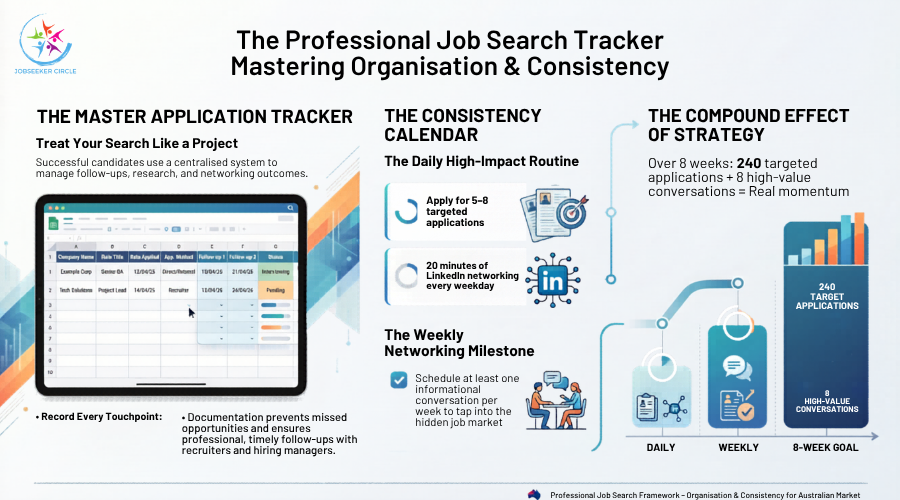
I’ve worked with hundreds of professionals. The ones who succeed fastest all have one thing in common: they treat their job search like a project, not a series of random applications.
What “Organized” Actually Looks Like
Track everything:
- Which jobs you’ve applied for (with dates)
- Which companies you’ve researched
- Who you’ve connected with on LinkedIn
- Follow-up dates and outcomes
Use a simple spreadsheet or tracking tool. Columns:
- Company name
- Role title
- Date applied
- Application method (recruiter/direct/referral)
- Follow-up date 1
- Follow-up date 2
- Status
- Notes
Why this matters: You can’t follow up effectively if you don’t know what you applied for or when. You can’t build relationships if you forget who you talked to. Organization isn’t glamorous, but it’s the difference between looking professional and looking scattered.
What “Consistent” Actually Looks Like
Not this: Applying to 50 jobs on Sunday, then nothing for a week.
This: 5-8 targeted applications per day, Monday to Friday. 20 minutes of LinkedIn networking daily. One informational conversation per week.
The math:
- 6 applications/day × 5 days = 30 applications/week
- 20 mins LinkedIn/day × 5 days = 1hr 40mins networking/week
- 1 informational conversation/week × 4 weeks = 4 new connections/month
Over 8 weeks:
- 240 targeted applications
- ~13 hours of networking
- 8 informational conversations
Compare that to the inconsistent approach:
- 240 random applications sent in bursts
- No networking
- No conversations
Same number of applications. Completely different outcomes.
Consistency compounds. The professional who networks 20 minutes daily for 8 weeks has built a network. The one who “doesn’t have time” has built nothing.
What This Means for Your Job Search in 2026
Let me translate everything above into actionable steps.
1. Make a Career Direction Decision
If you’re in a repetitive role that’s likely to be automated, decide now: adapt or pivot?
Adapt: Upskill into the strategic/oversight aspects of your function. If you’re a data analyst doing repetitive reporting, move into data strategy and insights.
Pivot: Move into roles that require human judgment, relationship-building, or creative problem-solving. AI can’t replace empathy, negotiation, or strategic thinking.
Don’t wait. The professionals who make this decision in 2026 will be ahead of those who wait until their role is already being phased out.
2. Apply the 3-Factor Match to Every Application
Before you click “Apply,” ask yourself:
- ✅ Do I have the core skills? (If no, don’t apply)
- ✅ Do I have relevant industry exposure? (If no, can I demonstrate transferable context?)
- ✅ Do I have experience in this operational/technology area? (If no, is there a clear connection I can draw?)
If you can’t confidently answer yes to at least 2 out of 3, you’re wasting your time applying.
3. Flip Your Time Allocation
Current approach (doesn’t work):
- 90% applying to jobs
- 10% networking
What actually works:
- 40% targeted applications (30-40 per week, properly customized)
- 40% networking (building target company lists, connecting on LinkedIn, informational conversations)
- 20% skill development (certifications, projects, staying current)
4. Write Like a Human, Not Like AI
When you’re writing your resume, cover letter, or LinkedIn profile:
- Use your voice, not corporate jargon
- Tell specific stories, not generic responsibilities
- Show your personality (professionally)
- Let AI help with structure, but write the content yourself
Test: Read your resume out loud. If it sounds like something a robot would say, rewrite it.
5. Follow Up Strategically
Every application should have a follow-up plan:
- Day 3: LinkedIn connection to hiring manager
- Day 7: Value-add email
- Day 14: Check-in message
Most people don’t do this. That’s your advantage.
6. Get Honest About Your Gaps
Our job search assessment data shows that most professionals score lowest in two areas:
- Application & Positioning (average: 56%)
- Job Search Execution (average: 48%)
What this means: Most people know they need a job, but they don’t know how to position themselves effectively or execute their search strategically.
What to do about it:
Take an honest assessment of where you stand. Not sure where your gaps are? Take our free 5-minute Australian Job Market Readiness Assessment to identify exactly what’s holding you back.
The Australian Job Market in 2026: Your Next Move
The Australian job market in 2026 rewards clarity, strategy, and human connection.
It punishes:
- Generic, spray-and-pray applications
- AI-generated resumes that lack personality
- Job seekers who only apply and never network
- Professionals who ignore the 3-factor match
It rewards:
- Targeted positioning
- Strategic networking
- Human-written content that tells your story
- Follow-up and persistence
The gap between what works and what doesn’t has never been clearer. The question is: which approach will you choose?
About the Author
Gaurav Wadekar is the founder of JobSeeker Circle and a 2026 IABCA Australia India Impact Award Finalist (Individual Category). With 8 years running 150+ community events and 20+ years in product and delivery leadership across organizations like Westpac, Sydney Airport, ASIC, and Fiserv, Gaurav helps internationally-trained professionals navigate the Australian job market with clarity and strategy.
Ready to take control of your Australian job search?
→ Take the free Australian Job Market Readiness Assessment (5 minutes)
→ Book a free 20-minute strategy call
→ Explore our coaching programs